

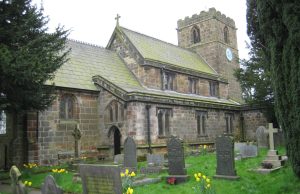
The earliest records of West Hallam date back to the Domesday Book of 1086, where it appears as “Halum” or “Hallum” and records the village of West Hallam as being owned by a man named Dunstan. William of Normandy (William the Conqueror) gave the village to his nephew, William de Gant, son of Baldwin, Earl of Flanders, when dividing land between his noblemen and warriors. Later, the village was held by the Norman nobleman Ralph FitzHubert, who owned a scattering of manors across Derbyshire. The entry records the existence of ploughlands, meadows, and woodland, painting a picture of a rural, agricultural settlement typical of the era.
During the Middle Ages, West Hallam was shaped by the feudal system. Land was largely controlled by the lord of the manor, and villagers—mainly agricultural workers—owed labour or rents in exchange for the use of land. The Church played a pivotal role in local life. The parish church, Saint Wilfrid’s, dates from the 13th century, with its enduring tower and medieval font standing as witnesses to generations of births, marriages, and burials. The church, with its stonework and stained glass, remains a focal point and architectural treasure of the village.
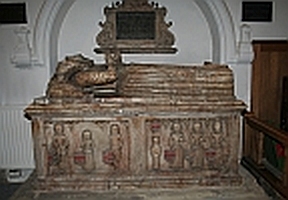 The manorial system dominated West Hallam for centuries. The manor passed through various hands, including the influential de Cromwell and Powtrell families. The Powtrells, in particular, left their mark on the village, with West Hallam Hall serving as their seat for several centuries. The Hall, though now lost to time, was once the scene of grand gatherings and local governance. The family was known for its Catholic sympathies, and some members suffered during the religious upheavals of the Tudor and Stuart periods. Local tradition holds that priests were sheltered in secret chambers during times of persecution. The church chancel houses a tomb decorated with effigies of Walter and Cassandra Powtrell and their seven children.
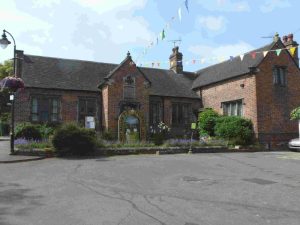
The will of Rev John Scargill made provision for the foundation of a school in West Hallam. The Scargill School for boys, originally sited opposite the church gates, opened in 1664. The school moved to a new site in School Square in 1832 and in the 1850s a Girls’ and Infants’ School was added. Reorganisation in 1935 saw the opening of a new County Secondary School in West Hallam to cater for pupils over 11 years old from a number of schools in the area. The school closed in July 1973 with pupils transferring to the newly built Kirk Hallam Secondary School. The school premises were subsequently taken over by the local primary school and have since been substantially extended. The school retained the name of Scargill School and the Scargill Foundation still exists and is managed by a board of trustees who use it to support local educational needs in the four villages. The old boys’ school, pictured, is now a private residence and the girls’ school is now the village hall.
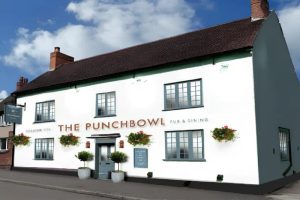
A number of public houses opened, most notably The Punch Bowl, White Hart and Newdigate Arms, which became social centres for the community.
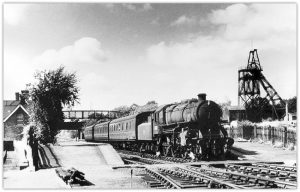
Though West Hallam retained its rural character longer than some of its neighbours, the Industrial Revolution left a marked imprint. By the 19th century, coal had become the lifeblood of Derbyshire, and the thick seams beneath West Hallam drew the attention of mining companies. Collieries such as Mapperley Colliery and West Hallam Colliery provided employment for many local men, while the arrival of the railways in the mid-1800s linked the village to larger markets and industrial centres. The railway was part of the Staffordshire link of the Great Northern Railway. The line linked the old Nottingham Victoria and Derby Friar Gate stations and around the end of the 19th century West Hallam Station dealt with 90,000 passengers a year. The last passenger train left in 1964 and the station is now Station House at the Stanley end of Station Road.
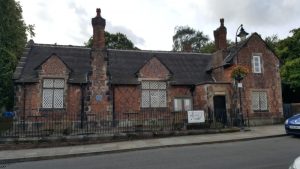
With mining came new housing, as rows of terraced cottages sprang up to accommodate workers and their families. The village expanded, and its population grew. Social life revolved around the local Working Men’s Institute, church, chapel, village hall (see photo) and sporting events. The village hall was previously the Girls’ School.
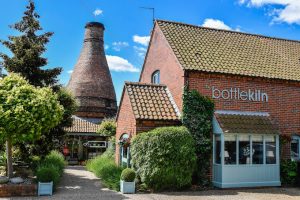
On High Lane West, close to its junction with St Wilfrid’s Road, bricks for the Newdigate Estate were made in the 19th century from clay dug locally and fired on the site. A saw-mill later replaced the brickworks, producing pit-props from locally felled timber, but the local clay was dug and fired again after 1922 when West Hallam Art and Earthenware Company built two bottle-kilns to make pottery, with a popular line in small animals, until the 1930s depression stopped production. Peak Pottery’s attempt to revive the industry a few years later fared no better, and for nearly 50 years the site stood idle. One kiln was demolished and its bricks reused; the other was gutted. Then in 1983, a local artist and ceramic sculptor bought the site, renovated the shell of the old kiln, and, reusing old materials, built a craft shop and cafe.
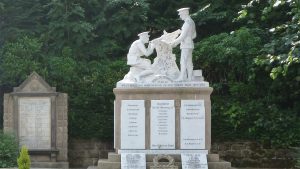
The 20th century brought both challenges and opportunities. The world wars touched every family, with many villagers serving in the armed forces and West Hallam’s War Memorial — standing in the heart of the village — bearing witness to lives lost. During the Second World War, the area became home to West Hallam Depot, a Royal Ordnance factory used for the storage and distribution of munitions.
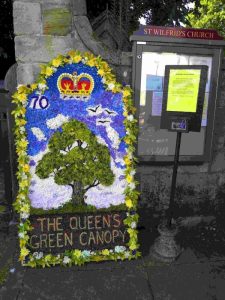
The unique Derbyshire tradition of elaborate pictures made for the most part of individual flower petals pressed onto clay covered boards seems to date from Victorian times.
West Hallam has a Well Dressing Festival on the 2nd Saturday in July where different organisations compete for the best display. A Scarecrow Competition is also held at the same time. The Festival includes a blessing of the wells.